

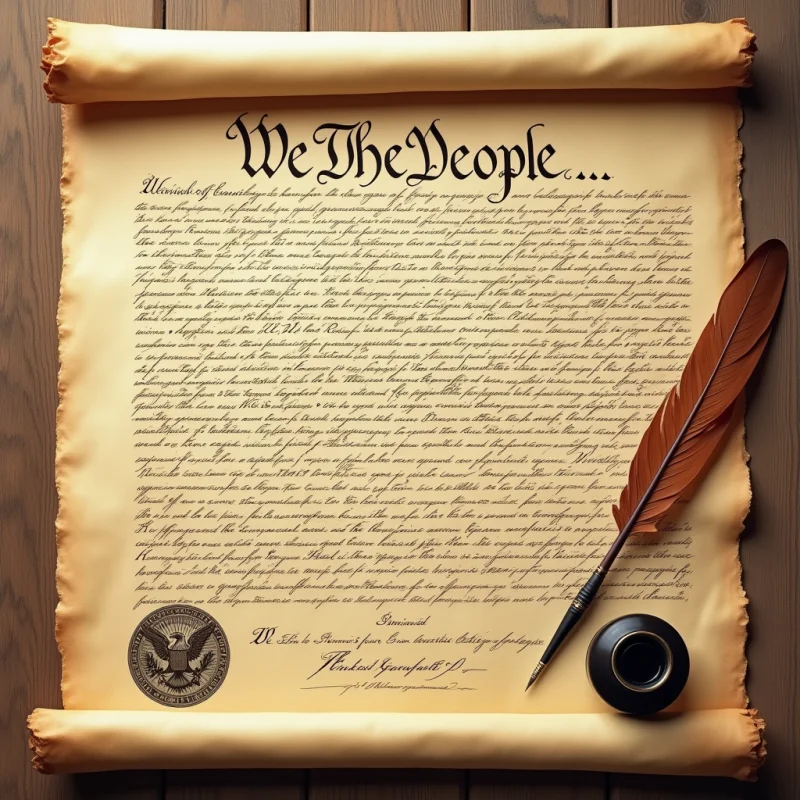
The United States Constitution
The supreme law of the United States, establishing the framework of federal government and guaranteeing citizens rights.
Description
About The Constitution of the United States
The United States Constitution, drafted in 1787 and ratified in 1788, is the supreme law of the United States and the oldest written national constitution still in use. This remarkable document established the framework for American government and has served as a model for democracies worldwide.
Historical Context
Following the American Revolution, the Articles of Confederation proved inadequate for governing the new nation. In May 1787, delegates from twelve states convened in Philadelphia to revise the Articles but instead created an entirely new constitution. After intense debate during the hot summer months, the Constitution was signed on September 17, 1787.
Structure and Key Features
- Preamble: “We the People” establishes popular sovereignty as the source of governmental authority
- Article I: Establishes Congress (the legislative branch) with its two chambers
- Article II: Creates the presidency and executive branch
- Article III: Establishes the Supreme Court and federal judiciary
- Articles IV-VII: Address federalism, amendments, supremacy, and ratification
Foundational Principles
- Separation of Powers: Divides government into three co-equal branches
- Checks and Balances: Each branch can limit the others’ powers
- Federalism: Balances power between national and state governments
- Amendment Process: Allows the Constitution to evolve while maintaining stability
A Living Document
Through 27 amendments, the Constitution has evolved to abolish slavery, extend voting rights, and address changing circumstances while maintaining its core structure. It remains the subject of passionate interpretation and debate.
This free ebook edition presents the complete original Constitution, essential reading for understanding American government and constitutional law.



Reviews
There are no reviews yet.